Key Takeaways
- SD-WAN streamlines network management by enabling centralized control and automation, allowing IT departments to handle complex network environments with greater efficiency and accuracy.
- Businesses benefit from reduced costs, improved security, and increased agility, as SD-WAN enables the flexible use of multiple connectivity types and dynamic responses to rapidly changing network conditions.
- Best practices for implementation ensure successful adoption and long-term value, from initial planning to ongoing optimization and monitoring in line with evolving business needs.
Understanding SD-WAN
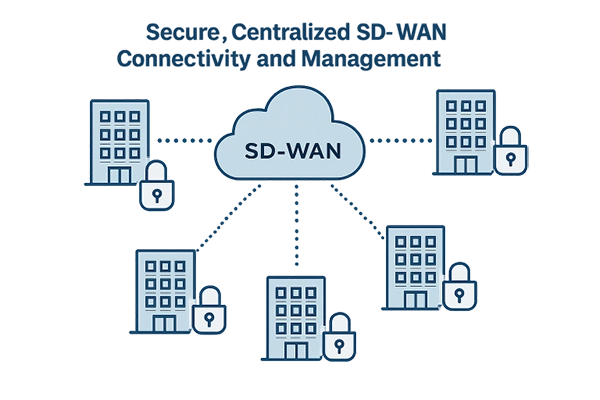
Modern businesses operate across multiple locations and require reliable, flexible, and secure network connectivity to support their teams, clients, and partners. As traditional Wide Area Networks (WANs) become increasingly complex and costly to manage, many organizations are transitioning to Software-Defined Wide Area Networking (SD-WAN) to overcome these limitations. By taking a software-based approach, SD-WAN abstracts network management away from hardware, empowering IT teams to control their environments through centralized platforms and intelligent automation. This enables organizations to respond quickly to business changes, integrate new branch locations with ease, and support the growing demand for remote and hybrid work without the constraints of outdated infrastructure.
A significant advantage of SD-WAN is its ability to leverage diverse transport services—including Multiprotocol Label Switching (MPLS), LTE, and broadband internet—to securely connect users to the applications they need, regardless of their location. Organizations seeking secure SD-WAN solutions benefit from streamlined operations, better visibility, and adaptive control over network flows. This shift reduces reliance on legacy solutions and provides greater agility for scaling businesses, allowing for the dynamic allocation of bandwidth and efficient prioritization according to real-time IT or business needs.
Centralized management, coupled with real-time analytics, allows IT teams to monitor every endpoint and application from a single dashboard. This control reduces troubleshooting times and simplifies policy enforcement, ensuring compliance and performance consistency across all networked sites. As attack surfaces expand with the proliferation of remote workers and distributed applications, integrated security in SD-WAN architectures plays a crucial role in defending against evolving threats, such as ransomware and sophisticated social engineering tactics that target endpoints or network infrastructure.
For businesses with multiple offices or remote workforces, the ability to dynamically route network traffic based on current conditions is particularly valuable. Modern SD-WAN ecosystems enable granular application prioritization, utilizing available bandwidth more efficiently and providing an uninterrupted user experience even as network demands fluctuate. In turn, staff productivity is maintained, critical business processes are uninterrupted, and costly downtime or application slowdowns are significantly reduced, helping the organization stay ahead in a competitive market landscape.
Key Benefits of SD-WAN
- Centralized Management: A single-pane-of-glass interface streamlines configuration, troubleshooting, and monitoring, lowering IT overhead and human error, while offering granular controls and audit trails for compliance reporting.
- Automated Traffic Routing: Advanced policy engines dynamically direct traffic along the best available path, optimizing for latency, cost, and application criticality. This helps prevent congestion and ensures that essential applications receive the necessary resources to perform optimally.
- Enhanced Security: SD-WAN solutions often include encrypted tunnels, segmentation, and embedded firewall capabilities to protect sensitive data and defend against cyber threats. Integrated security layers ensure compliance with regulatory standards and limit lateral movement in the event of a compromise.
- Cost Efficiency: Organizations reduce operating expenses by incorporating affordable broadband connections alongside—or in place of—costlier MPLS or leased lines, freeing budget for innovation while maintaining network reliability and performance.
As noted in Network Computing’s breakdown of SD-WAN advantages, companies adopting SD-WAN typically see improved uptime and easier branch office expansions, as configuration becomes faster and less dependent on manual intervention. These improvements directly contribute to operational resiliency and competitive advantage. The agility enabled by SD-WAN empowers businesses to respond quickly to market shifts, regulatory requirements, or sudden spikes in digital activity, supporting both growth and stability.
Implementing SD-WAN: A Step-by-Step Guide
- Assess Your Current Network: Begin with a thorough review of your infrastructure and connectivity requirements. Identify bottlenecks, security vulnerabilities, and underperforming segments to target for improvement, ensuring an informed baseline for your SD-WAN deployment. As outlined in Forbes’ guide to SD-WAN implementation steps, understanding your current environment is crucial to building an effective strategy.
- Define Business Requirements: Clarify objectives such as desired cost savings, compliance mandates, application priorities, and security needs. This foundation will guide solution selection and deployment strategies, anchoring the initiative to measurable business outcomes.
- Select an SD-WAN Solution: Choose a vendor or platform that aligns with your organizational goals and integrates smoothly with your current environment. Consider scalability, security features, vendor support, and compatibility with your existing cloud and networking stack.
- Plan Deployment: Develop a strategic rollout plan that aligns with your business schedule and minimizes disruptions to ensure a seamless implementation. Define resource allocation, migration steps, timelines, and fallback options to ensure stakeholders are prepared for each phase.
- Monitor and Optimize: Utilize analytics and monitoring tools to assess network performance after implementation. Regularly review and update policies to adjust for evolving usage, security requirements, and growth patterns, maximizing the return on your SD-WAN investment.
Conclusion
SD-WAN technologies continue to redefine how businesses manage and secure their wide area networks. Through centralization, automation, and integrated security, organizations achieve higher efficiency, resilience, and operational agility. With careful planning and a focus on business-specific requirements, SD-WAN adoption leads to a future-proof network architecture that grows with your enterprise and provides a clear pathway for digital transformation. As workloads shift to the cloud and users become increasingly distributed, SD-WAN provides the adaptability and performance necessary to support ongoing growth and innovation.